ash work protocol
Ash is what remains after something has burned. It is quiet but carries the history of what came before. It marks a moment of change.
Ash exists between being and disappearing. It is not the original form, but it is not nothing. It shows that after destruction something is still present.
This work uses ash as a symbol of transformation. It reflects on endings but just as much on continuation.
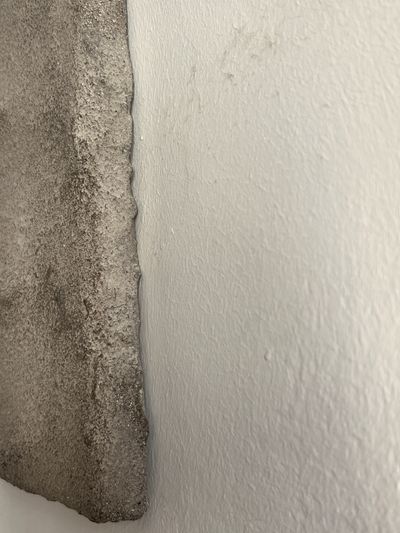
The eye is highly sensitive to the color grey. Its appearance can shift depending on the light the eye has recently been exposed to.
The grey in these works is made from ash alone. It holds a surprising vibrancy. This intensity does not come from color in the conventional sense, but from the material itself and the way it holds and transforms light. Unlike acrylic or oil paint, which is suspended in a forming binder and dries into a relatively unified surface, ash settles onto the canvas as a field of irregular particles. Each fragment fine dust or larger grain catches and absorbs light differently.
The surface is ultra matte and micro textured. Its broken particulate structure reduces specular reflection and therefore increases diffuse absorption. Rather than bouncing light back in a single direction, it scatters and holds it.
The result is a grey that appears softer and active rather than flat. Ash is not a single tone. It contains carbon, mineral residue, calcium, and trace elements that produce delicate shifts between warm and cool greys.
What reads from a distance as monochrome is, up close, a quiet constellation of tonal differences. The eye registers this internal variation as vibrancy. The surface seems to breathe.
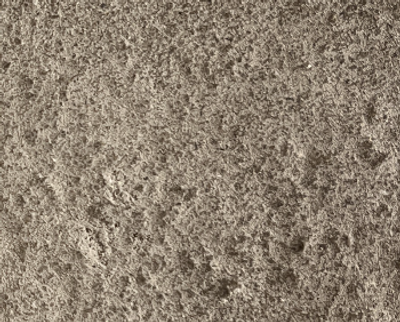
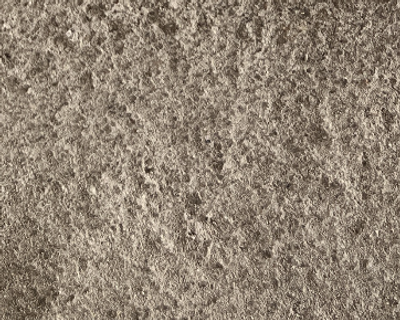
Grey does not exist as a single wavelength of light. The color created by the brain is a low-intensity mix formed through reduction.
Through this process, the surface begins to resemble something geological rather than pictorial. It does not read as a layer applied to the canvas, but as a material that has settled, accumulated, and stabilized over time.
The surface appears dry, porous, and mineral. Light is absorbed into its uneven micro-topography rather than reflected outward, giving it a depth that feels embedded rather than coated.
This shifts the perception of the work away from image and toward object. It resembles stone, cooled lava, or compressed sediment. The grey does not appear constructed but formed.
This association emerges from the material itself. Ash is already the result of transformation through heat. In this state, it carries a physical memory of combustion while simultaneously resembling the inert stability of geological matter.
This ambiguity situates the work between the temporal and the geological. It no longer refers only to an event of burning, but to processes of settling, compression, and becoming material.